Bubbu & Mimmi World
- 3.8
- Rating
- 10.00M
- Installs
- Free
- Price

 Analysis by App-foxy
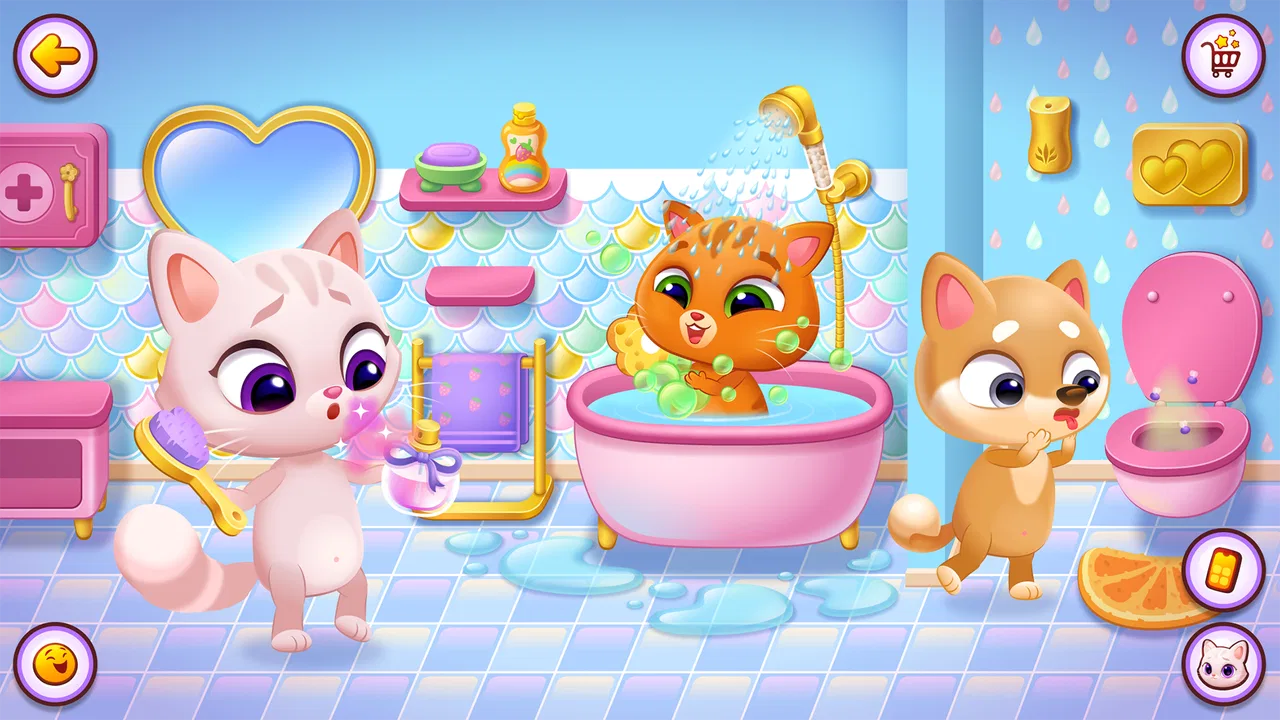
I spent time with Bubbu & Mimmi World as a relaxed, child-friendly casual game, and my first impression was clear: it is built around gentle interaction rather than pressure. You explore, look after the two characters, and discover small activities at your own pace. That makes it easy to understand, especially for children who want something more open-ended than a puzzle with a timer.
The game comes from Bubadu, a developer already associated with accessible animal-themed experiences. Here, the focus is shared between Bubbu and Mimmi, giving the world a little more personality than a single-character care game. I found that the appeal is less about reaching a difficult goal and more about returning to familiar characters, trying different interactions, and creating a short play session whenever there is a spare moment.
It is available as a free game for Android, with optional in-app purchases ranging from $0.99 to $59.99 per item. That distinction matters: you can begin without paying, but the presence of purchases means parents should check the device’s purchase settings before handing it to a child. The age rating is Everyone, and the game requires Android 6.0 or later.
You May Also Like

 Blood Strike: 2.5 Anniversary
Blood Strike’s Loadouts Turn Every Drop Into a Tactical Gamble
A close look at Blood Strike’s custom loadouts: how fast access to signature weapons reshapes its battle royale rhythm, rewards preparation, and narrows the gap between fights.

 Pandora - Music & Podcasts
Pandora’s Music Is Easy to Start, but Harder to Recover
Pandora’s strength is its low-effort path from a seed to a station. Its weak spot is how much confidence it asks you to place in connection, setup, and quiet recovery.

 8 Ball Pool
 Is Built on Rivalries, Rematches, and Routine
A close look at the rivalries, rematches, shared routines, and unanswered safety questions that turn a quick pool match into a persistent mobile community.

 Samsung Music
’s Quiet Strength Is Playing What You Already Own
Its reach comes less from spectacle than from dependable access to a personal library. That simplicity is both the app’s strongest retention engine and its ceiling.

 AccuWeather: Weather Radar
AccuWeather Review: A Quick, Clear Forecast for Everyday Decisions
For everyday plans, the best forecast is the one you can understand quickly. AccuWeather makes rain timing, radar, and local conditions easy to act on, with a few trade-offs.

 Hill Climb Racing
Why Hill Climb Racing Still Turns Crashes Into One More Run
A tiny car, a bumpy hill and one more upgrade: Hill Climb Racing keeps resurfacing because its simple chaos makes every near-miss feel personal.
More From Our News Desk



How Bubbu & Mimmi World feels to play
I found the best way to judge Bubbu & Mimmi World is to notice whether its relaxed pace suits the player, rather than expecting a stream of goals or rewards. In this section, I look at how its character-focused play can fit short, everyday moments and what to watch for when deciding whether to keep it in a child’s rotation.
A soft introduction for younger players
The central idea is simple enough to explain in one sentence: explore the world, care for Bubbu and Mimmi, and learn through playful activities. I did not need a long tutorial to understand what the game wanted me to do. The characters and their surroundings provide the invitation, while the player decides which interaction to try next.
That simplicity is one of its strongest qualities. A child who is still learning how menus and touch controls work is less likely to feel lost here than in a game built around several layers of missions, equipment, or competitive progress. The experience encourages curiosity instead of demanding perfect timing.
At the same time, adults should set realistic expectations. This is a casual game, not a structured educational course or a deep simulation. The wording about learning fits best when understood as learning through exploration, recognition, and routine play, rather than formal lessons with measurable results.
Why the two-character setup helps
Bubbu and Mimmi give the game a social feeling even when one child is playing alone. Switching attention between two animal companions can make ordinary care activities feel less repetitive, because the player is not interacting with only one face in every situation. I also found that the pair makes the world easier to use as a shared activity between a child and an adult.
For example, a parent can ask which character the child wants to visit first, what each one might need, or what part of the world looks interesting. Those questions turn a short session into a conversation without requiring the adult to take over the controls. That is a more useful role for the game than simply leaving it running as background entertainment.
The trade-off is that players looking for a strong story may find the character relationship fairly light. The appeal comes from interaction and repetition, not from dramatic plot development. If your child needs a clear narrative with chapters and a final objective, a story-driven adventure may hold attention better.
Small sessions work best
I think the game fits naturally into short periods: after school, during a quiet break, or while waiting somewhere. Its casual structure makes it easy to open without committing to a long campaign. That is helpful for younger players, whose attention can change quickly and who may prefer several small visits over one extended session.
A practical routine is to let the child choose one character, spend time exploring, and then stop after completing a small personal goal such as checking on the character or trying a new activity. This approach avoids turning free play into a demand to keep going. It also makes the game easier to share with siblings, since each child can take a turn choosing what happens next.
There is a less positive side to this format. If you want a game that constantly introduces new challenges, rewards precise skill, or gives a strong sense of advancement, the relaxed design may feel thin. The same freedom that makes it approachable can also make it feel less urgent for older children.
What the free entry really means
The free starting point is important because it lets a family judge the basic experience before spending anything. I would use that opportunity rather than assuming every optional purchase is necessary. Let the child play long enough to see whether the characters and activities genuinely hold attention, then decide whether any paid item adds meaningful value for your household.
Because individual purchases can cost from $0.99 to $59.99, the price range is wide. A small purchase and a high-priced purchase should not be treated as equivalent value. I would especially avoid allowing unsupervised buying on a child’s device, since a child may understand the game but not understand that tapping a purchase can involve real money.
The fairest way to view the cost is this: the free access gives you a chance to evaluate the core experience, while the optional purchases are a separate decision. I cannot call the paid side automatically good value for every player, because value depends on what those items add to your particular use. What is clear is that the game does not require an upfront purchase to be tested.
What I would check before giving it to a child
I would first open the game myself, explore the available areas, and look at where purchase prompts appear. This is not a criticism unique to Bubbu & Mimmi World; it is simply sensible whenever a free children’s game includes paid items. I would then enable the device’s purchase protections and explain to the child that free play and buying something are different actions.
I would also decide whether the game is being used for independent play or together with an adult. For independent play, a short agreed time limit works better than relying on the child to stop naturally. For shared play, the game can become a useful prompt for naming objects, describing actions, and practicing simple choices.
Another useful tip is to avoid presenting every available interaction at once. Let the child investigate one area or one character first. This makes the world feel manageable and gives the player a sense of discovery instead of turning the screen into a list of tasks.
How it compares with familiar casual alternatives
Compared with a conventional puzzle game, this title is less focused on solving a defined problem. A puzzle usually tells you what success looks like, while this experience leaves more room for wandering and care. That makes it a better choice for children who enjoy pretend play, but a weaker choice for someone who wants clear goals and increasingly difficult challenges.
Compared with a competitive casual game, it is much calmer. There is no reason to choose it for leaderboards, fast rounds, or testing reflexes. Its value is in creating a friendly setting where the player can interact without feeling judged by a score. Children who become frustrated by failure may appreciate that difference.
Compared with a traditional virtual-pet game, the presence of Bubbu and Mimmi gives the experience a broader social flavor. Still, I would not choose it solely because it has two characters. The right question is whether your child enjoys exploring and caring for animated companions. If the answer is yes, the pair supports that interest; if the answer is no, the extra character will not solve the basic mismatch.
Useful ways to play beyond simply tapping around
One of the better ways to use the game is as a conversation starter. Ask the child to describe what happened, predict what a character might need, or explain why they selected a particular activity. This adds language practice and decision-making without pretending that the game replaces a lesson or a real-world routine.
A second approach is to use it as a calm transition between activities. After a busy part of the day, a brief visit with the characters can be easier to manage than a highly competitive game. I would keep the session clearly bounded, though, because a calm game can still make stopping difficult if the child expects to continue indefinitely.
A third approach is shared turn-taking. One player can choose the character while another chooses the place or activity. This works particularly well with siblings because it gives each child a role. It also reveals a limitation: if the game is mainly designed for one person touching the screen, group play may be conversational rather than genuinely multiplayer.
These uses show where the game has more value than its simple premise suggests. It can support imaginative talk, gentle routines, and cooperative attention. None of those benefits should be exaggerated into formal educational claims, but they are practical reasons a parent might prefer it over a more frantic alternative.
Where the experience may lose momentum
The biggest possible weakness is repetition. Care and exploration games often rely on returning to familiar actions, and that can be comforting for one player but boring for another. If a child wants a constant stream of new mechanics, the open-ended format may not provide enough variety over time.
There is also a difference between being easy to start and being rewarding for a long-term player. The accessible controls help at the beginning, but older children may soon ask what they are working toward. I would therefore treat the game as one option in a wider collection, not as the only game on a device.
The purchase structure is another point of friction. Free access is convenient, but optional items create a boundary that adults need to manage. A family comfortable with parental controls may find this straightforward. A family wanting a completely purchase-free experience should be more cautious and inspect the game before allowing independent use.
Device compatibility is relatively broad because the game supports Android 6.0 and later. Even so, I would install it on the actual device that the child will use and check how comfortable the controls feel on that screen. Compatibility does not automatically mean that every device offers the same comfort, visibility, or responsiveness.
Who will get the most from it
I would recommend it most to younger players who like animal characters, gentle exploration, and pretend-care activities. It is also a good candidate for parents searching for a free starting point rather than committing to a paid game immediately. The Everyone rating makes it suitable to consider for a broad family audience, while adult supervision remains sensible because purchases are available.
It may also work for children who are easily discouraged by losing. The relaxed structure gives them room to interact without the constant pressure of a timer or opponent. For a child who prefers making choices and seeing friendly characters respond, that can be more inviting than a skill-based game.
I would skip it, or at least test it briefly first, if your main goal is serious academic learning, a long narrative, competitive challenge, or a deep management system. It is not the right tool for every kind of play. A focused spelling app is better for spelling practice, a puzzle collection is better for deliberate problem-solving, and a competitive game is better for players who want scores and mastery.
My value judgement
From a cost perspective, the strongest part is the ability to begin for free. That lowers the risk of discovering that the style does not suit your child. The optional purchase range means I would not describe every paid choice as automatically worthwhile, and I would make any spending decision only after seeing how much the child actually uses the free experience.
In practical terms, the game delivers its best value when it becomes a short, repeatable activity: a few minutes of exploration, a care routine, or a shared conversation. It delivers less value when someone expects a large adventure, constant novelty, or a complete educational program. That distinction is more useful than simply calling it entertaining or family-friendly.
The rating of 4.0 from around 19 thousand ratings suggests that many players find something enjoyable here, while the total of over 10 million installs shows that the concept has reached a large audience. Those figures are useful context, but they do not replace trying the free version with your own child. A popular casual game can still be a poor fit for a player who wants difficulty or a clear ending.
My final recommendation
Bubbu & Mimmi World is worth trying when you want a free, gentle animal-care game that encourages exploration rather than competition. I like its approachable premise, its two-character setup, and the way it can support small moments of shared play. The game knows what kind of experience it wants to be, and it does not need complicated systems to make that first visit understandable.
I would recommend downloading it for a child who enjoys friendly companions and open-ended interaction, then watching how they use it before considering any purchase. Keep purchase controls active, set a comfortable play routine, and treat the game as casual entertainment with playful learning opportunities rather than a substitute for structured education.
My verdict is a cautious yes for the right audience. The free entry makes testing easy, the Everyone rating broadens its family appeal, and the Android requirements are not demanding. The main reasons to skip it are a need for deeper progression, stronger educational structure, or a completely purchase-free environment. If those are not priorities, Bubadu’s gentle world around Bubbu and Mimmi can make a pleasant addition to a child’s casual game collection.
FAQs for Bubbu & Mimmi World
01What is Bubbu & Mimmi World about?
Bubbu & Mimmi World is an interactive adventure game designed for children and families. Players explore a vibrant world with Bubbu the cat and Mimmi the dog, engaging in activities like cooking, gardening, and dressing up. It's a blend of creativity and fun, fostering imagination and interactive learning.
02Is Bubbu & Mimmi World safe for children?
Yes, Bubbu & Mimmi World is designed with child safety in mind. It features age-appropriate content, no aggressive ads, and parental controls to ensure a safe gaming environment. The app is regularly updated to adhere to safety standards, making it a trustworthy choice for young players.
03What devices support Bubbu & Mimmi World?
Bubbu & Mimmi World is available on both Android and iOS platforms. It supports a wide range of devices, from smartphones to tablets, ensuring accessibility and portability. Make sure your device meets the minimum operating system requirements to enjoy a smooth gaming experience.
04Are there in-app purchases in Bubbu & Mimmi World?
Yes, Bubbu & Mimmi World offers in-app purchases for additional features, costumes, and virtual items. While the basic version is free, these purchases enhance gameplay. Parents can manage and restrict purchases through device settings to prevent unintended spending by children.
05Does Bubbu & Mimmi World require an internet connection?
Bubbu & Mimmi World primarily operates offline, allowing uninterrupted play without an internet connection. However, some features, such as updates or certain interactive elements, may require internet access. This setup ensures flexibility and convenience for users on the go.
Pros
- Engaging and colorful graphics.
- Easy to navigate for young users.
- Wide variety of mini-games.
- Encourages creativity and exploration.
- Regular updates with new content.
Cons
- Some in-app purchases required.
- Can be laggy on older devices.
- Ads can interrupt gameplay.
- Limited offline features.
- Requires constant internet connection.

Bubbu & Mimmi World
Gallery